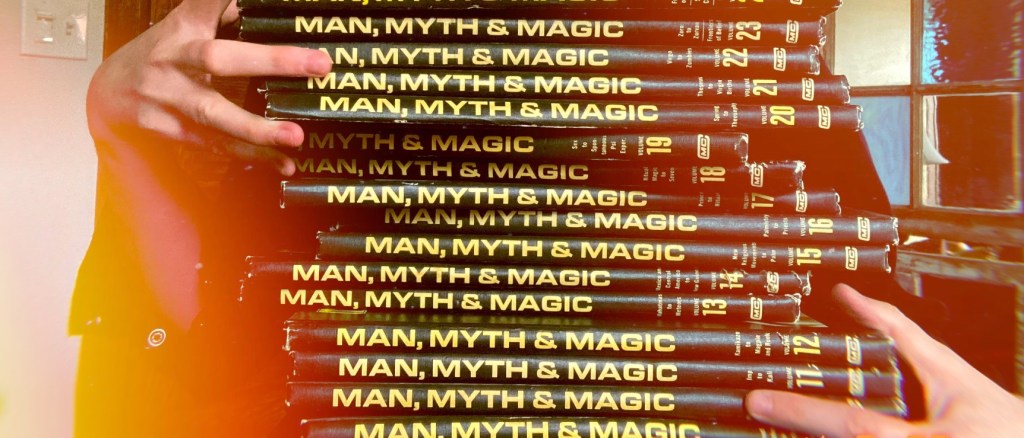
As an archive of strangeness and a place of seemingly ancient knowledge, the reference books at the public library often have a mysterious quality about them. They typically sit tucked away in a dimly-lit corner, only to be utilized when someone has a specific question that the internet can’t provide, which is seldom these days. Reference materials also can’t be checked out with a library card, almost defying the purpose of the library as providers of free materials that you can take home. When I started a job at a new library last fall, I noticed the reference section was old and crusty, and full of neglect. But then I saw it: a 24-volume encyclopedia set from the 1970’s on all things occult in religion, witchcraft, and the supernatural section. The encyclopedia was aptly named Man, Myth and Magic: An Illustrated Encyclopedia to the Supernatural. And it sits on a shelf in my house too.
Man, Myth and Magic was a weekly magazine that was released mostly in the UK and Australia, spanning 112 issues. It was also available in the US at several stores, including Dominick’s Finer Food Stores and Walgreens, according to the above video from 1974. Edited by Richard Cavendish, Man, Myth and Magic featured scholarly articles written by prominent specialists in folklore, spirituality and the supernatural. The editorial board included John Symonds, author and literary executor of Aleister Crowley; and Cottie Arthur Burland; formerly in the Department of Ethnography at the British Museum. The encyclopedia was bound into 24 volumes in 1970, and reprinted into 21 volumes 1995. A five-volume set was released in 2014, bound into subjects such as Witches and Witchcraft and Animal Symbols in World Culture. I purchased the 1970 edition because the covers of the volumes are illustrated as well, while the 1995 version is dark blue with standard gold writing. There was also a failed 1980’s RPG with the same name, but to my knowledge, they are not related.
Man, Myth and Magic begins with the following words: “The supernatural is the night sky of our minds, the shadow side of our mental daylight, of reason and hard fact. Like the night, it contains mystery, beauty, enchantment and horror. It has a powerful attraction and almost all of us, one way or another, are involved in it.” Each volume covers dozens of different topics, from abracadabra to Merlin to whales. According to the introduction, it was intentional not to separate the articles into subjects (religion in one, mythology in another, etc), but rather to place them all together in alphabetical order, almost to encourage discovery and browsability. “Palmistry to Priests,” “Imp to Kali,”and “Virgo to Zombies” are some of my favorite spine labels. “We often talk about the modern age as a time of materialism, reason, technical and scientific advance,” Cavendish writes in his introduction, “but the supernatural still plays a vitally important part in the world we live in. Many people, still, are religious. Many people still believe in astrology, palmistry and a variety of superstitions.” In other words, it makes sense that all of these topics are interfiled, as the supernatural is something that links us all.
While Man, Myth and Magic covers a variety of diverse topics, it’s not without its problems. For instance, encyclopedias are often out of date shortly after they were published, and this one is over 50 years old. While it featured over 200 educated scholars writing entries, the editorial board consists of most if not all white men and only around ten women who contributed articles. This lack of diversity begs you to read the volumes with a critical eye, as some of the subjects are about non-Eurocentric beliefs and cultures and bibliographies are short. But the book also seems to encourage this type of critical thinking and skepticism. From the introduction by Cavendish: “you will find a variety of views in this encyclopedia– though we have avoided the extremes of uncritical credulity on the one hand and a passionate skepticism, equally unconnected with the evidence, on the other.” It seems like the encyclopedia was intended to be used as a time capsule of the esoteric during the 1970’s, rather than an enduring definitive guide. Think critically and use the subjects as a jumping-off point if you want to pursue further research on topics unfamiliar to you.
When we started weeding our reference collection at the library, Man, Myth and Magic was the first to go. It was moldy, stained, and crumbling (before you come at me, weeding is a necessary part of any library collection, as both mold and disinformation are dangerous). Even though I’m pretty unsentimental about weeding, it was a shame to discard this beautiful set. If you want to purchase a magazine, a volume, or the whole set of Man, Myth and Magic, you could check eBay, used bookstores or local book sales. At my library, we are not allowed to keep or sell discarded books, so I purchased the set on eBay from a bookstore in Pennsylvania. After some research, I decided it was cheaper to get a whole set at once than try to piece together volumes throughout the years. I’m not willing to reveal how much money I spent on this, but I’ll just say it cost less than a Hogwarts Lego Set but more than my state tax return.
Anyone who has perused the library stacks knows that the reference section is sublime. Its contents are both entrancing and frightening, unusual and ordinary. It has a mythology of reverence, yet anyone can use it. Man, Myth and Magic holds this same inherent special power. It is not an everyday reference set, but once-in-a-blue-moon, you’ll find yourself taking it off the shelf. As Cavendish states: “We have not set out to convert you, to or from anything, but to explain the structures of ideas which men have built in the past, and which they continue to build now. You must decide for yourself where truth and value lie.” One thing is for certain, you will never find a more comprehensive encyclopedia on the esoteric and supernatural.
You can explore digital volumes of Man, Myth and Magic: An Illustrated Encyclopedia to the Supernatural on The Internet Archive.
 Chloe's Not Scared
Leave a comment